Leh to Nubra Valley in Autumn: A Golden Scape


A cancelled flight to Lakshadweep and a few meetings at the Air India office later, my mother with her excellent negotiating skills managed to save our plans of that autumn from spoiling. With one day to shop and prepare for the impromptu trip, we made quite a few mistakes there; but, we all learn from mistakes. Don’t we? The next eighteen hours were sleepless. No, we were not flying abroad. I just could not manage to get any amount of sleep at the airport, in layover. Flights are not frequent to this area. There is no train station nearby either. We boarded the flight from Delhi the morning following our departure from Guwahati. By noon, we were in Leh’s Kushok Bakula Rimpochee Airport.
Tourists are not allowed in the union territory for several months a year. Many hotels would also close down temporarily during winters for the same reason. The best time to explore the place is from May to October. To participate in the Chadar trek, you must visit in January or February and get permission for the same, beforehand. To witness the Apricot Blossom festival, visit in mid-April.
Accommodation is available in the form of hotels, guest houses, and home-stays. The hotels are top-notch. They come with heated beds and water supply, and clean bathrooms. The hospitality is also awe inspiring. However, food might reach your room half chilled or you might freeze on your way to the dining area.

At noon, in mid-October, when we landed in Leh, the temperature was one degree Celsius. Usually, the temperature ranges from -7 to 3 degrees Celsius in October in the capital of Ladakh. Passes are another story. The temperature at those heights, drop as low as 15-20 below zero. The clothes I bought the day before were suitable for Leh depending on one’s tolerance to cold. However, when travelling through Ladakh, one needs to put on one or two layers of inner thermals followed by heavy and thick coats and sweaters for the torso. A wind cheater makes everything better. For your legs, fleece trousers or joggers over thermals to block the wind is suggested. I wore skinny jeans over thermals. That did not just make me uncomfortable, but also made my jeans stretch and unusable later. Feet need to be warm all the time as I am sure that no one wishes to have frostbite. A few pairs of socks paired with insulated shoes do the job. As for your hands, it is advisable to wear one or two pairs of gloves. I believe biker’s gloves do the job better. Ear muffs, mufflers, beanies, sunglasses, and sunscreens are must haves while travelling in the area. Chilling is an understatement for the winds there. The sun does not shine, it glares at you. Although it does not feel burning on the skin because the cold biting your skin cancels the heat from the sun, staying under the sun for prolonged periods without protection does make you feel the burn even in such cold. If the sun is out while travelling through the high passes, the reflection from the snow will feel blinding without sunglasses.

Cold is not the only setback for your trip there. Situated at an altitude of 2900 metres to 5900 metres, the pressure up there is lower than that on the sea level. Oxygen is low. Breathing gets extremely difficult at higher altitudes. So much that one may go through severe headaches and nose bleeds if not acclimatised well. So, it is highly advised to stay in Leh for a day or two before venturing out of the capital towards remote areas. Higher altitudes are unavoidable in a trip like this as commuting from one mountain to another is only possible through passes. Some of the highest motorable passes lie on this side of the world.
So, how do you spend the first two days acclimatising? Getting a day’s sleep on a cosy and heated bed after a tiresome plane journey sounds enticing. However, I suggest that you leave it for night time. Chances are, your body will react badly to getting out of your room at night on the first day itself. Instead, in the day time, try to look around the local shops and try out exotic local cuisines. They are usually low on spices and that saves you from getting gippy tummy. I, on the other hand, tried out local food on the last day and regretted as I realised that I missed out on a lot. On the second day, you can visit tourist attractions in Leh.

I spent my first day (or, half of it) in the Leh Palace and Shanti Stupa. The architecture is strikingly unique. What caught my eyes were the steep wooden staircases, roofs made by stacking wood of the size of twigs balanced on thicker wooden beams. They depict Tibetan style of architecture. The entire structure of the palace is built with mud, stones, wood, and sand. It is still intact till date. Some rooms have now been collectively turned into a museum. The Shey monastery is attached to the palace.
The Shanti Stupa, a white-domed Buddhist monument, was built in 1991 by a Japanese monk Gyomo Nakamura as a part of the Peace Pagoda Mission to promote world peace on marking 2500 years of existence of Buddhism. It is built atop a hillock and provides mesmerising views of the entire city. The Stupa also contains relics of the Buddha.

The first thing that struck me right after landing in Leh was the yellow leaves. They were so bright compared to the dull colours of the rugged mountains, it felt like dry spring. I have been romanticising autumns, ever since. The mountains, although dull in colour, had different rock patterns. I tried hard to remember class 7 geography to identify them.
The following day, we headed to Nubra valley and visited every tourist place that we came across en route. We skipped Pangong Tso to visit in the return trip and visited the Hemis and Diskit monasteries instead. We drove through Khardung-la at 5359 metres above sea level. On our ascent and descent, we saw vehicles skidding, slipping, and falling on hard ice from the snow fall that occurred the day before. Below us, we also saw smashed cars covered in snow. It did not help my state of mind at all. Some vehicles had chains on their wheels, we did not. On tricky parts, our driver would let cars behind us overtake us to judge if we should proceed or not. The roads were muddy when not icy. Soldiers pushing cars stuck in mud was probably the most common sight on those altitudes after army convoys. At some point, it felt like the number of defence persons posted there were more than the number of locals.
After we passed through the scary parts of the road, we chatted with our guide cum driver. We found out that he and most Ladakhis have lost touch with their families residing in Tibet. The Buddhist families would send one of the kids, usually the youngest and male, to a monastery to become a monk. There are monasteries that have residence for nuns, but people preferred to send their sons. On asking why, our new found friend replied that the infrastructure and living conditions provided for the nuns are not comparable to that of the monks.
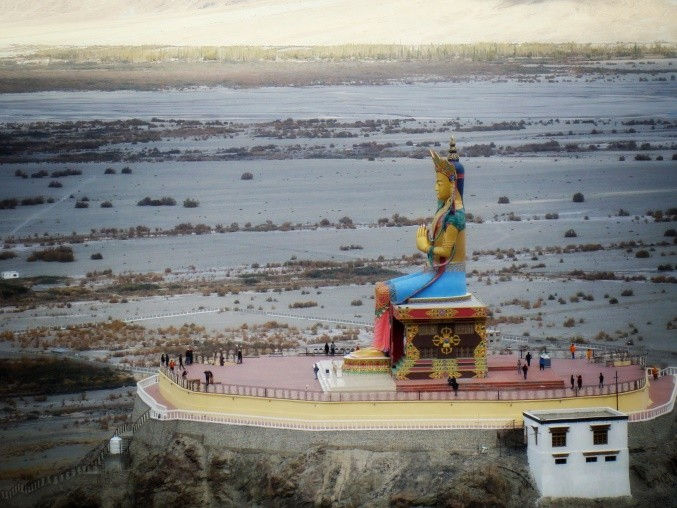
Nubra is the northern-most valley of India. It is known for its orchards, various monasteries, and Bactrian camels. The Nubra River, a tributary of the Shyok River which originates in the Siachen glacier, accompanies people all the way to Nubra valley. From the highways thousands of feet above the valley and the river, the plains looked like a beautiful painting, almost unreal. The river felt like life in the middle of barren sand and rocky-mountains. It added a splash of bright turquoise in the otherwise grey and brown backdrop. The closer we got to the valley, more colours kept popping up. They were colours of autumn –orange, red, brown, bright yellow, and some dark green. That is what made me fall for the season. At times, Bactrian camels would climb the steeps and get close to the roads. As we got to the plains, we were welcomed by unending stretches of white sand dunes. We stopped at the quad biking spot. Then we proceeded to Diskit Monastery. A 32 metres tall statue of Maitreya Buddha overlooks the monastery. There we saw monks picking up litter left behind by tourists even though there was a bin not even 4 feet away.

Nubra valley, to me, is the most beautiful valley to exist. Or, maybe it was the seasonal colours that put me under a spell. The vegetation there was new to me, the colours, the mountains, the houses, the animals, the fragrance, and the air, too. The wind was chilling, but people were warm. There was no electricity in the village when we arrived. We were provided fire heated water to freshen up. It made me nostalgic. Back in my childhood, we had a mud stove at our village home. I would watch my grandparents cook on the fire during festivals. Shortly, we went out and rode on camels. In India, the Bactrian camel, which has two humps instead of one, is found only in Hunder. They were the main form of conveyance during trade with central Asia, centuries ago. Although I remember everything I did in Nubra, I have little memory of the sequence. On our last day in the valley, the hotel we stayed in gave us a carton of apples grown in their orchard. The orchards of Nubra produce apples, apricots, walnuts, wheat, and barley. In spring, the apricot blossoms paint the valley pink and purple. Apparently, the valley is called the orchard of Ladakh. I was not surprised.

On the day of our return to Leh, we stopped at Pangong Tso and Chang-la. Pangong Tso, situated at a height of almost 4,350m, is the world’s highest saltwater lake. Extending to almost 160km, one-third of the Pangong Lake lies in India and the other two-thirds in China. Pangong Lake is also known to change colours, appearing blue, green and red at different times. By the time we reached the lake, the weather had worsened greatly. The lake from afar was blue. From close, the water was so transparent, one could count the stones underneath. Our driver drove us near the last village on the Indian side. The deteriorating weather did not allow us to stay for long. We had to drive past the passes, and we could only hope for the weather to get better.
At Chang-la, my parents stepped out of the car to take photos when it started snowing. I and my brother, in our tired and cold states, did not realise that it was snowing till after two years had passed. So, we missed the snow fall.

On the supposed last day in Ladakh, we drove to places nearby Leh. In Nimmu valley, at Sangam: the confluence of Indus and Zanskar, the two rivers of visibly different colours merge to become one. Indus originates in Tibet while Zanskar originates in Zanskar valley. The water was calm and so was the weather. The sun was out and we felt warmer than the day before. Sadly, we would be leaving in a day. We were already planning another trip here so that we could go to Kargil and Zanskar. By our time of return, we had made friends with the hotel crew. They came and shared about their time in Thailand and the training they underwent there. One of the cooks made us some Thai soup. I, unfortunately, do not remember the name.
The next day, we arrived at the airport. After waiting more than half a day, we went back to the hotel allotted by Air India. It was the same hotel we stayed in. This time, we were shifted to the suite. Had we known our days in Ladakh would increase by one, we would spend it better than we did.
Some challenges I faced during the long car drives up and down the mountains are car sickness, dehydration, migraine, and the urge to use the washroom. There are not many washrooms in the way. I declined my driver’s suggestion to go behind the rocks. What I have learned is to try using the loo wherever it is available –in the rare petrol stations or somewhat frequent dhabas and shops. The bigger lesson I learned is to drink way more water in higher terrains than we do in the plains. It helps to maintain the bowel movements. Also, back then, I had no idea what food my body could not tolerate. So, knowing your body properly helps while travelling. Had I known my body well, I would have avoided breads and parathas in the morning.
For a comfortable journey, the trick is to know your own biological system well and research about the place you are visiting, especially the cuisine there or the availability of food options. Since ours was an unplanned journey, we missed out on a few things and did a few others wrong. I keep planning to go back there and do everything right, maybe alone someday. Or, maybe I will take my parents with me again.

Comments